

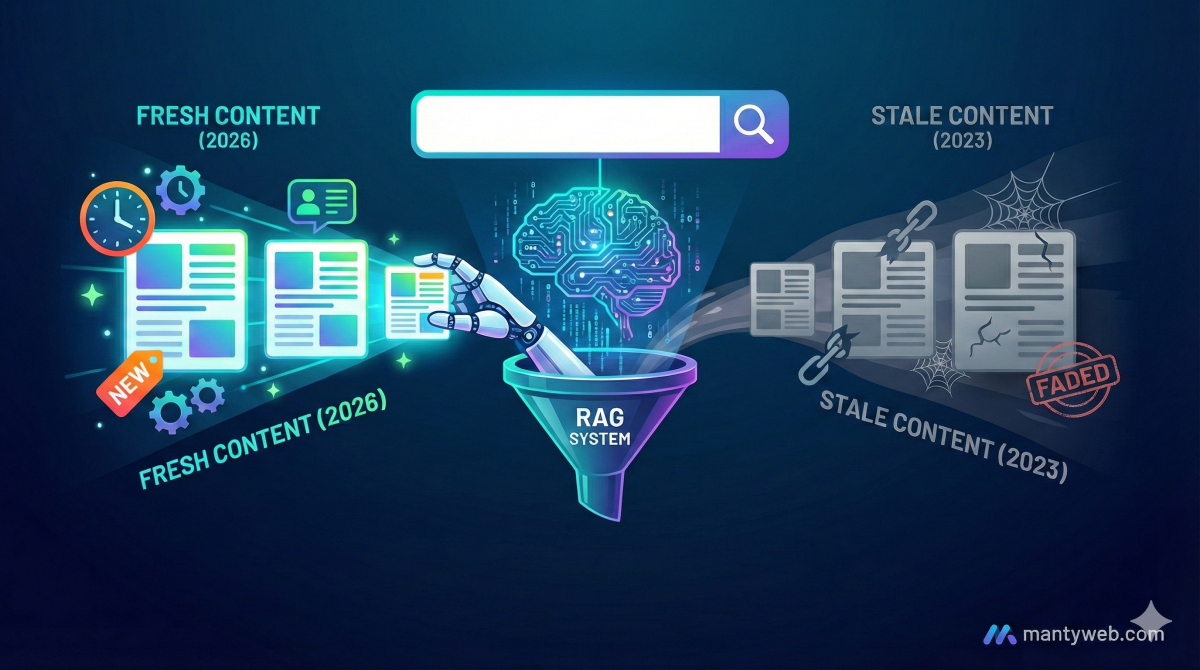

If you want to understand how RAG systems actually work under the hood, this article by Pedro Dias at Visively is one of the better reads out there. It covers vector embeddings, hybrid retrieval, re-ranking thresholds, and why information gain matters more than keyword density. Better than 90% of the AI SEO content floating around right now.
But it is more academic than operational, and it leaves out a measurable and important ranking signal in production AI search today: content freshness.
If you are just getting started with AI SEO strategy, our Complete Guide to GEO and AEO Optimization covers the foundational concept. If you want to focus on just one thing, content freshness is a good one to start with. And if you have a WordPress site click here to check out our AI Friendliness WordPress Plugin to get recommendations for all your website content right inside of WordPress.
Why You Need To Keep Your Content Updated
Content recency is one of the most visible selection signals across the major AI search platforms that have been measured so far. Perplexity, ChatGPT Search, Google AI Overviews, Gemini, and Copilot often surface recently updated pages, especially for anything involving pricing, product specs, industry data, regulations, or fast-moving topics. (Ahrefs)
The reason makes sense once you understand the architecture. Retrieval-augmented systems (RAG) use retrieval and browsing to supplement the LLM’s training cutoff, because the model itself cannot know what happened after its training data ended. When these systems trigger retrieval for time-sensitive queries, they inherit ranking and selection biases from the underlying index and reranking layers, and recency is often one of those signals. That bias can flow into what the system chooses to cite. (Ahrefs)
A concrete example: if your page lists 2024 pricing and a competitor updated their pricing page in January 2026, their page will often get cited first for “best X price” style queries, even if your content is otherwise better written. Freshness is not the only factor, but for queries where the topic changes quickly, it is often the deciding one.
The Data Backs This Up
This is not speculation. Several studies have now quantified the freshness bias in AI citations, and the numbers are striking.
Ahrefs analyzed 16.975 million cited URLs across AI assistants (including ChatGPT, Perplexity, Gemini, Copilot, and Google AI Overviews) and found that AI-cited content averages 1,064 days old (about 2.9 years) versus 1,432 days (about 3.9 years) for traditional organic results, a gap of roughly 25.7%. Nearly a full year’s difference at scale. (Ahrefs)
Seer Interactive dug into AI bot crawl and visit behavior by content age and found that nearly 90% of AI bot hits occurred on content updated within the last three years, with 65% targeting content published within the past year alone. This crawl behavior correlates with citation opportunity: content that AI bots are not visiting is unlikely to end up in AI-generated responses. (Seer Interactive)
Passionfruit compiled research showing ChatGPT had the strongest recency bias of any platform, with 76.4% of its most-cited pages updated in the last 30 days. That is a striking number worth noting, and it also appears in Ahrefs’ AI SEO stats roundup, which helps triangulate the claim. (Passionfruit)
The pattern is consistent across every platform and every study: fresh content gets cited more.
Which Pages to Update First
Not all content decays at the same rate, and not all queries reward freshness equally. Google’s concept of “Query Deserves Freshness” (QDF) is a useful frame here: some queries have a built-in expectation of current information (pricing, product comparisons, regulations, stats, trends), while others are fine pulling from older evergreen content.
A simple decision rule for prioritizing your update effort: focus on pages where all three of these are true. First, the topic changes quickly enough that a one to two year old answer is likely outdated. Second, the page historically earned traffic or leads. Third, the content includes specific data points like dates, statistics, pricing, or comparisons that can go stale.
Your top 20% of pages by traffic is the right starting point, but layer in topic velocity before you commit time to a refresh. A well-trafficked page on a slow-moving topic can wait. A moderately trafficked page on a fast-moving topic should move up the list.
What “Real” Updates Actually Look Like
The good news is that content freshness is one of the most actionable things you can do for AEO/GEO without rebuilding your site or overhauling your content strategy. You do not need to rewrite everything.
What “real” changes look like in practice: replace at least one outdated statistic with a current one, add a new section or paragraph reflecting recent developments in the topic, update any screenshots or UI paths that have changed, and refresh the conclusion to reflect the current state of things. Ahrefs found a freshness advantage whether you measure by original publish date or by last-updated date, which supports the point that this is not just a timestamp game. The systems are looking for genuine semantic change.
A few other things that move the needle: include freshness signals in the content itself, phrases like “as of Q1 2026” or “updated March 2025” serve as textual cues that retrieval systems use to assess recency. Make sure your dateModified field in structured data reflects actual update dates. For articles, use Article or BlogPosting structured data and keep dateModified accurate so machine-readable metadata matches the visible “last updated” signal. (Google for Developers) Keep your “last updated” date visible on the page because both users and AI systems respond to it.
One thing to avoid: updating a publish date without making substantive content changes. Google and AI systems can detect superficial updates, and doing this consistently can actually hurt trust and visibility rather than help it.
Freshness vs. New Pages
One common misread is treating “freshness” as a reason to constantly update everything rather than to publish new content. Ahrefs explicitly notes that over-investing in updates to low-quality or low-relevance pages will not help, and there is an opportunity cost: sometimes publishing something new is the better move.
The practical takeaway for most sites is to build a lightweight refresh cadence around the pages that matter rather than trying to keep everything perpetually current. Identify your highest-value pages on fast-moving topics, put them on a quarterly or semi-annual review schedule, and let slower-moving content ride longer between updates. That kind of system is sustainable and produces compounding results over time.
The Bigger Picture
The Visively article is worth reading for the architectural understanding. But understanding how RAG systems work is only half the job. The other half is knowing which signals to act on in your actual content strategy, and freshness is too well-documented to leave off the list.
AI search is not just rewarding content that is well-structured and semantically relevant. It is rewarding content that is demonstrably current. If your site is sitting on pages that have not been touched in 18 months, those pages are likely being passed over in AI citations right now, regardless of how well-written they are.
The opportunity is real and the execution is not particularly complicated. Build a refresh cadence, make the updates substantive, and do it consistently. That alone puts you ahead of most sites chasing the more esoteric AEO tactics while leaving the basics on the table.
For a complete breakdown of AEO, GEO, and LLMO strategy, see our Complete Guide to GEO and AEO Optimization.
Further reading:
- Fresh Content: Why Publish Dates Make or Break Rankings and AI Visibility via Ahrefs
- Study: AI Brand Visibility and Content Recency via Seer Interactive
- Why AI Citations Come from Top 10 Rankings via Passionfruit
- Why Content Recency Matters for AI Search: Understanding RAG and Real-Time Retrieval via Evertune
- How LLMs and RAG Systems Retrieve, Rank, and Cite Content via Visively